



 April 2026
 A recent decision from the General Court offers a clear reminder of how strictly EU law treats motion marks that overlap with the functional aspects of a product. The case is centred on a short animation showing a window opening and closing and an attempt to register this movement as a trade mark at EUIPO.
Background
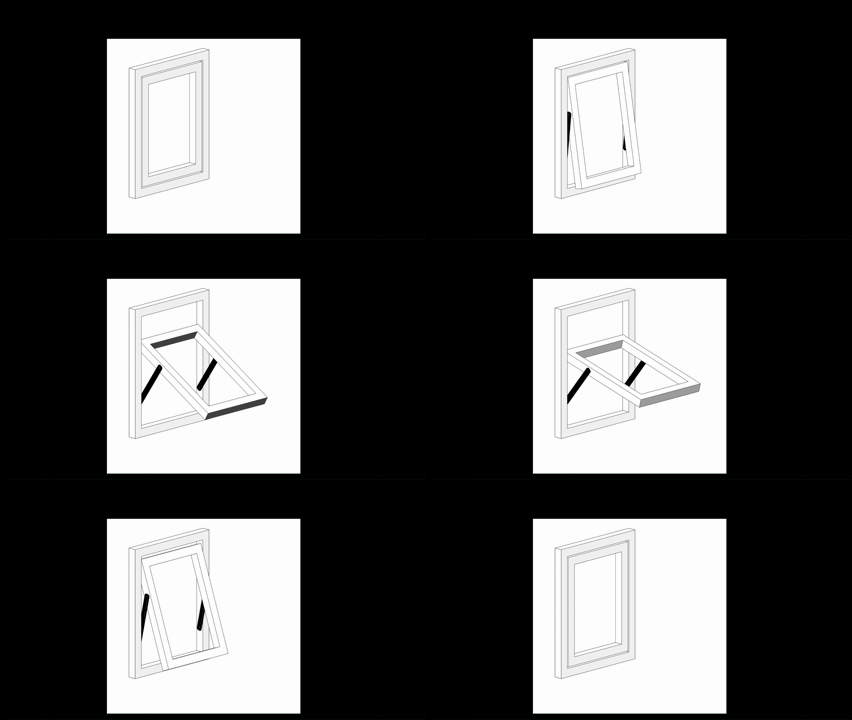
The applicant Kct GmbH & Co. KG filed an application for a motion mark depicting the opening and closing of a window, as depicted below.
The EUIPO rejected the application for lack of distinctiveness, and the Board of Appeal upheld that decision, finding the sign both non‑distinctive and functional. The applicant then brought the matter before the General Court, arguing two key points:
- The sign is not technical in nature, and
- It has distinctive character.
Assessment of the technical nature of the trade mark
The court began the assessment of the trademark by identifying the essential features of the sign and discussing whether those features provided a technical purpose. The applicant argued that only the sequence of movements should matter for trade mark protection and not specific visual details of the window. The court disagreed. It held that the essential features included: the opening of the window, the closing of the window, and the presence and movement of a spacer that enables the mechanism. The court concluded that these elements were all directly related to how the window operates, thus making the trade mark functional in nature.
The applicant attempted to argue that additional visual aspects such as the inner frame changing colour during movement should be treated as essential and non‑functional. The court rejected this argument, noting that the colour change was merely the natural effect of light and shadow on a moving three‑dimensional object and that it did not add any independent, non‑functional character to the sign.
The applicant also tried to argue that the visibility of the black spacer during the window’s movement was an imaginative feature. The court again disagreed, finding that the spacer’s movement was a necessary component of the window’s technical operation. The court further elaborated that granting trade mark protection for the motion would effectively give the applicant a monopoly over a functional mechanism, which trade mark law does not permit.
Finally, the applicant claimed that consumers would perceive the movement as unusual and therefore distinctive. The court dismissed this point, emphasising that consumer perception is irrelevant when assessing technical functionality of the mark. The question is whether the feature is necessary for a technical result and not whether consumers understand the mechanics behind it.
Accordingly, the General Court upheld the finding that the sign consisted exclusively of technical features and could not be registered.
Assessment of the distinctiveness of the trade mark
The applicant also challenged the Board of Appeal’s conclusion that the mark lacked distinctiveness, arguing that the Board had failed to consider all elements of the sign, particularly the visibility of the black spacer when the window is open, which the applicant claimed consumers would recognise as characteristic of its products.
In response, the court held that once a sign was found to consist exclusively of features necessary to achieve a technical result, that alone is sufficient to refuse registration and there was no need to examine distinctiveness further. Accordingly, the General Court dismissed the appeal in its entirety.
Summary
The decision reinforces a consistent message in EU trademark law:
- Motion marks are highly susceptible to functionality exclusion,
- Any feature that is necessary for a product’s technical operation cannot serve as basis for trade mark registration, and
- Attempts to rely on consumer perception or minor aesthetic effects will not overcome a finding of technical functionality.
While non‑traditional marks offer creative branding opportunities, they face strict scrutiny when they overlap with the functional aspects of a product’s design. This case is a reminder that the boundary between design and trademark protection remains firmly drawn, and applicants need to demonstrate a genuine non‑functional, distinctive element if they hope to secure registration for a motion mark.