


 June 2026
 EU General Court Case T‑24/25, Les Éditions Albert René v EUIPO
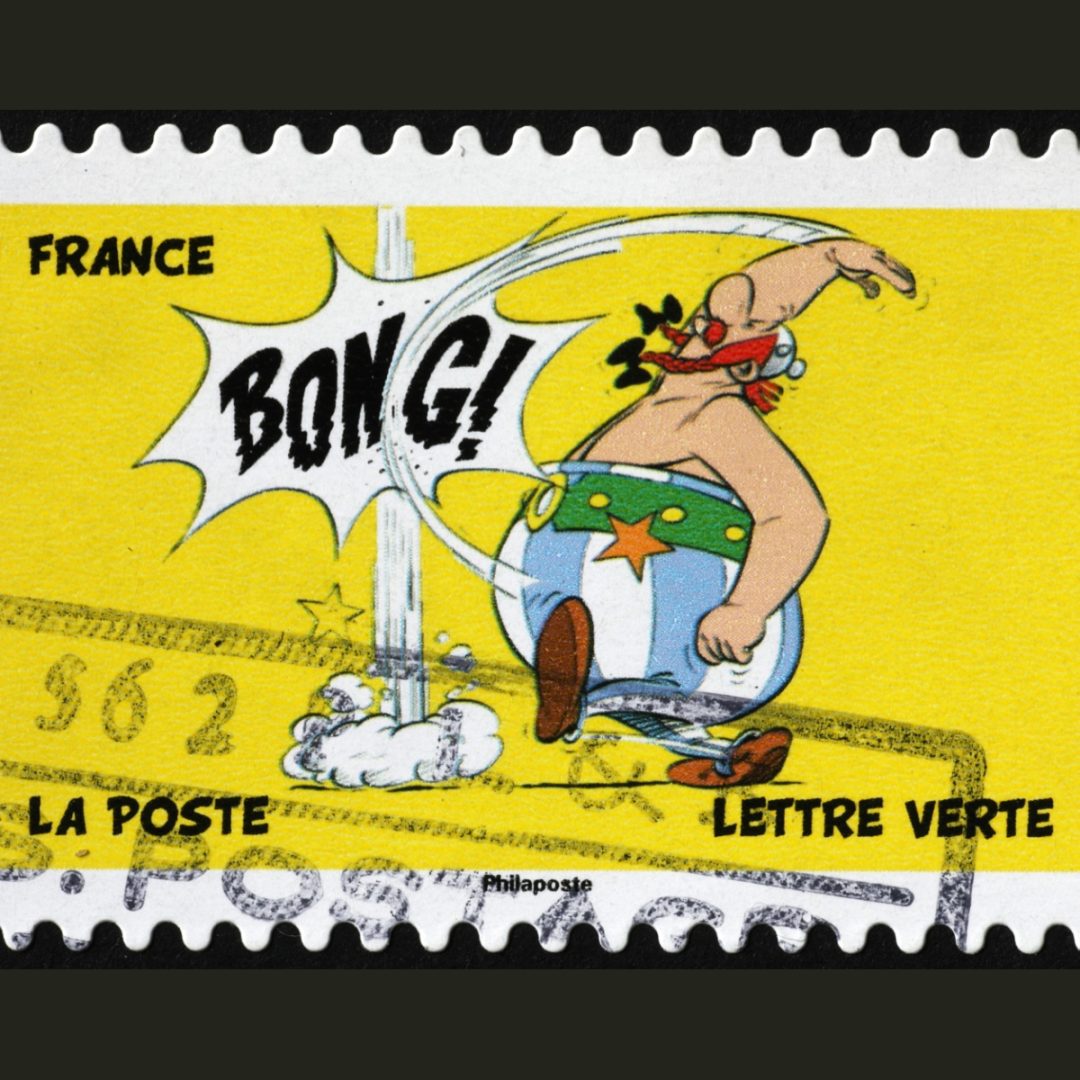
Asterix® and his best friend Obelix® are, of course, indomitable. Furthermore, Obelix’s name has a reputation across the European Union (EU) as confirmed by the EU General Court in case T‑24/25.
While our two Gaulish friends may appear inseparable, their names, and the trade marks attached to their names, are individuals and in this case the trade mark Obelix in classes 9, 16, 25, 28 and 41 (covering products ranging from printed matter to games, playthings, clothing and entertainment services including film production and amusement parks) were pitched against a Polish company, Works 11 Michał Lubiński, and their trade mark “Obelix” registered in 2022 for a range of weapons and accessories (e.g., tanks and machine guns).
As in many battles there were different stages, and as in all the best Asterix and Obelix stories, the Gauls had to overcome setbacks on the way to winning out in the end.
Act I
Works 11 Michał Lubiński filed an EU trade mark application in 2020 for the word mark “Obelix” (and the French version “Obélix”). As noted above, the mark was registered for various types of weapons.
This drew the attention of the French publishers who manage the IP rights of Asterix and Obelix (Les Éditions Albert René; “LEAR”). LEAR registered the word marks “Obelix” and “Obélix” in 1998 for the goods noted above, which are decidedly not weapons.
However, in proceedings before the cancellation division of the European Union Intellectual Property Office (EUIPO) LEAR advanced their case that there was a likelihood of confusion between the two, otherwise identical, trade marks because of the significant reputation of the Obelix trade mark connected with LEAR’s commercial activities.
However, the Cancellation Division of the EUIPO did not find in LEAR’s favour as they considered that LEAR had provided insufficient evidence to prove genuine use of the Obelix trade mark in the classes for which it had registered it. (T-24/25, para 6).
Act II
Accordingly, LEAR appealed to the EUIPO’s Board of Appeal (“BoA”). In contrast, to the Cancellation Division the BoA assumed that genuine use of the earlier mark had been established. However, the BoA considered that there was no likelihood of confusion as to the origin of the goods under the trade mark because the goods and services were dissimilar.
However, the BoA considered that a “definite conclusion” regarding reputation of the Obelix trade mark was not sufficiently supported by the evidence submitted by LEAR. Thus the BoA dismissed LEAR’s appeal.
Act III
Thus we reach the present case, T-24/25, wherein LEAR appealed to the General Court. While accepting that there was no likelihood of confusion between their trade mark and the contested trade mark, LEAR relied on the reputation of the “Obelix” trade mark flowing from their commercial activities.
The General Court first confirmed that the trade mark signs are identical but that they are directed at different sections of the “relevant public”. The relevant public for LEAR’s, earlier, trade mark was the general public as a whole. In contrast, the judges accepted that the contested mark is targeted at a very specialised public and, rarely, members of the general public complying with strict rules regarding weaponry.
Regarding the reputation of the earlier Obelix mark, the General Court noted that the BoA had not properly considered the “®” symbol used next to the term “Obelix”. The General Court considered that this indicated to consumers that the term “Obelix” is a trade mark. This contrasted with the BoA’s finding that the relevant public would not perceive the sign “Obelix” as a trade mark but rather “as a mere descriptive reference to a character from the comic book series in question”.
In addition, the General Court noted that “the BoA failed to take into account the fact that it is apparent from the evidence submitted in the proceedings before the EUIPO, including the images reproduced in the contested decision, that the applicant provided examples of various products on which the “®” symbol, which means ‘registered trade mark’, is affixed to the right of the term “Obelix” or “Obélix”. Similarly on several items of evidence where the term “Obelix” or “Obélix” is used with the term “Asterix” or “Astérix” the “®” symbol is affixed separately next to each of them”. Thus the General Court was explicit that the relevant public purchasing the goods would consider the presence of the “®” symbol as indicating that the term “Obelix” is a registered trade mark and that it serves as an indication of the commercial origin of the goods in question.
The BoA in their decision considered that because the earlier and later “Obelix” trade marks were registered for groups of goods and services that do not overlap, then this excluded the finding of a link between the marks.
However, regarding this conclusion the General Court considered that the BoA had not taken all of the relevant factors into account because neither the uniqueness and degree of distinctiveness of the earlier mark nor the degree of reputation gained by the mark in use had been considered by the BoA. Rather, the BoA had incorrectly focused only on the lack of overlap between the goods and services for which each of the marks was registered.
Thus the General Court annulled the decision of the BoA and furthermore, and unusually, ordered the EUIPO to bear its own costs and to pay one half of the costs incurred by LEAR. Furthermore, the General Court also ordered Works 11 Michał Lubiński to also bear its own costs and also to pay one half of the costs incurred by LEAR.
Conclusion – The Magic Potion of Reputation
This decision would appear to expand the protection given to owners of trade mark rights in characters used in books, films, and comics. This case demonstrates that the reputation that characters have gained through appearing in these media establishes wider protection in further trade mark classes, even for those that do not overlap with the original registration. Thus reputation has acted as a “magic potion” in the Gauls’ fight for trade mark rights (not that Obelix needs any magic potion… we all know the story about him falling in the druid’s cauldron when he was a baby…).
In considering this case, it is particularly notable that the General Court focussed on the use of the ® symbol and the indication to the general public. Other commentators have noted that this is a stronger interpretation of the effect of affixing the ® mark than indicated in other case law of the General Court (e.g., T-46/25 or T-205/20 at para. 91). Thus, decision T-24/25 moves away from those decisions and shows the value of attaching the ® symbol in the context of providing goods and services, especially if there is any ambiguity or doubt as to whether the sign should be perceived by the general public as a trade mark, as might be the case for fictional characters shown in published or broadcast media.